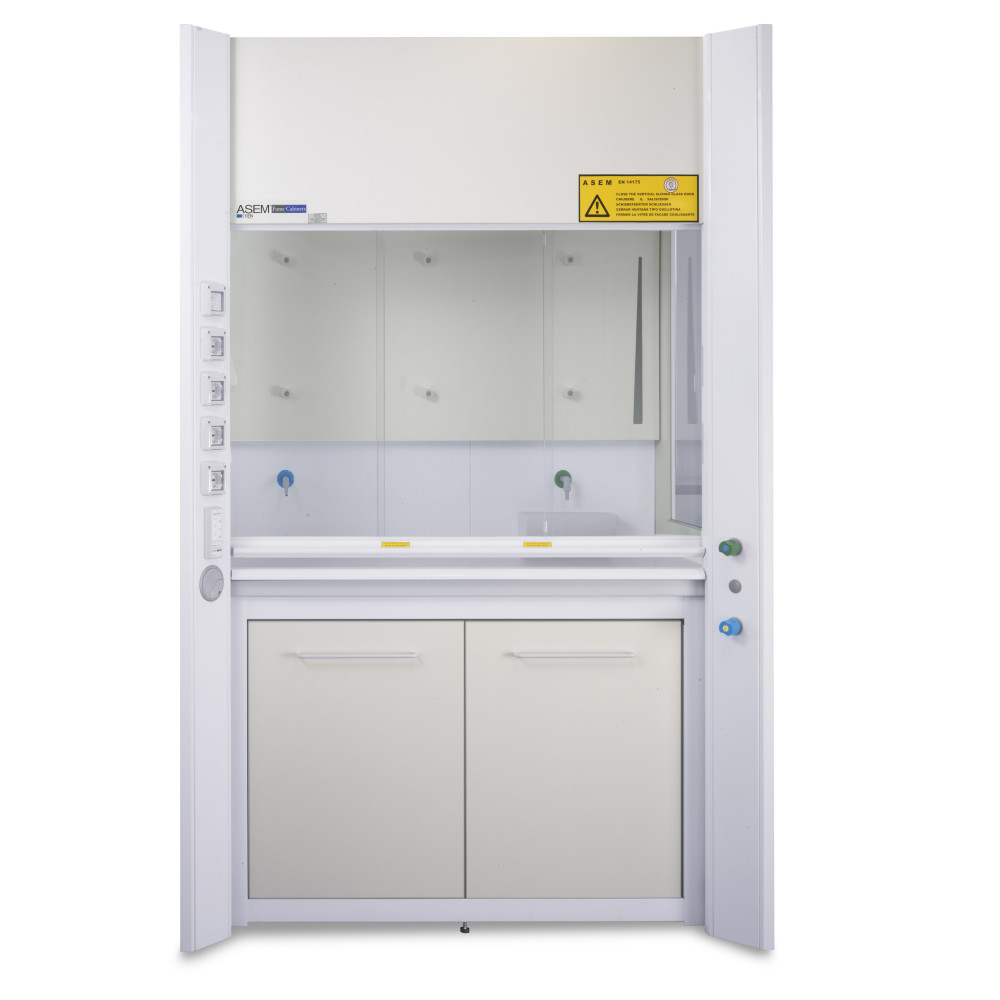
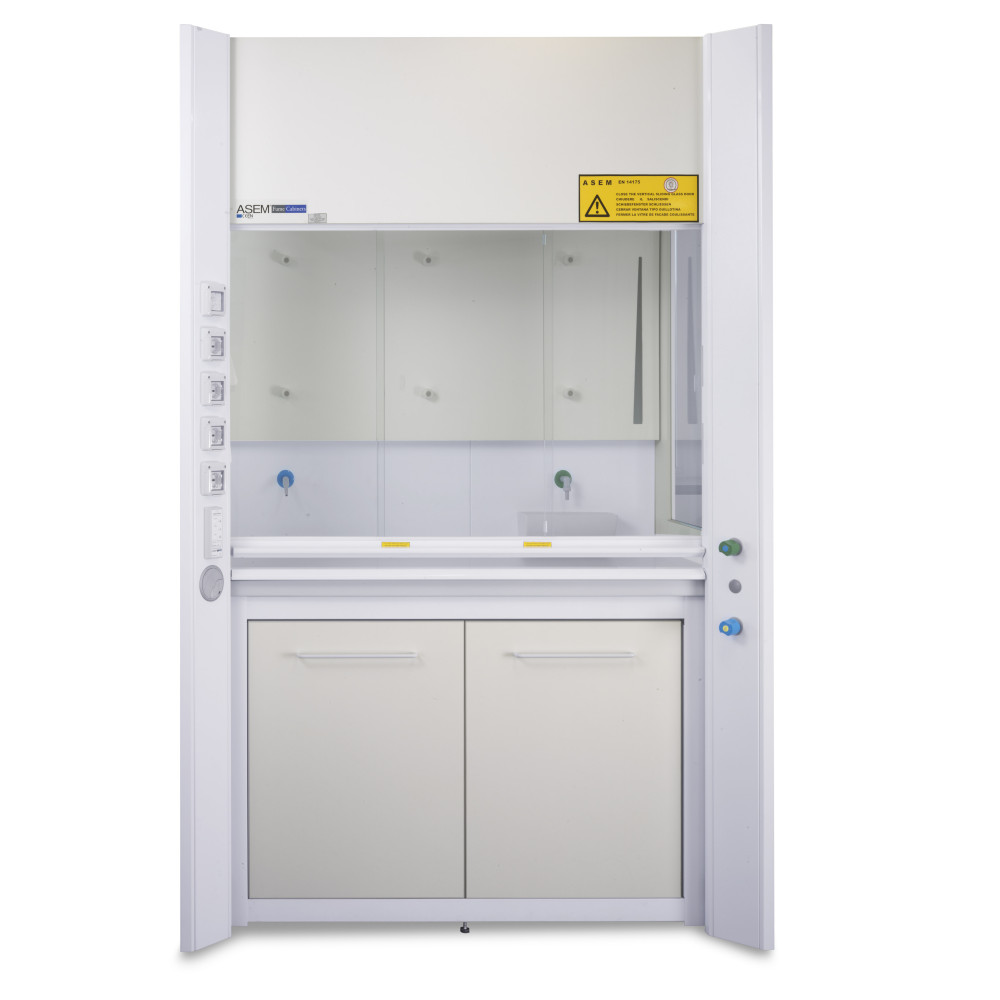
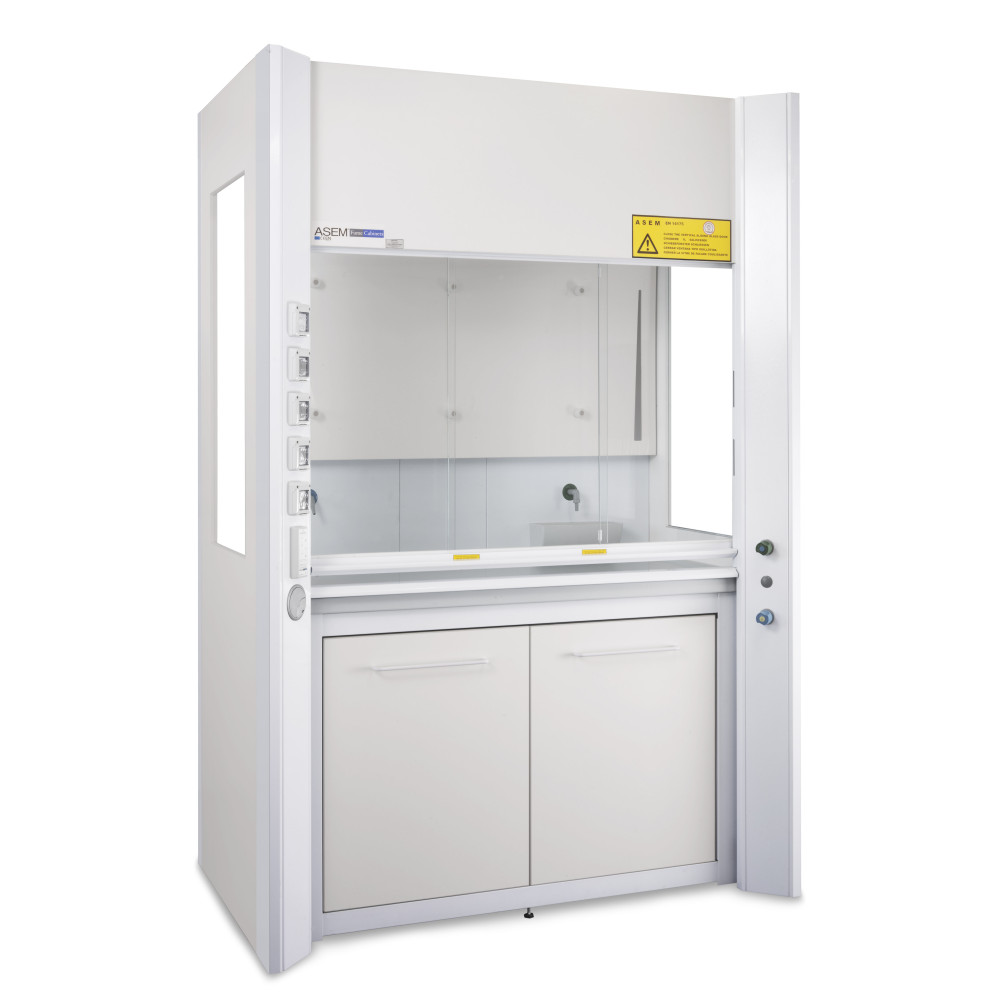
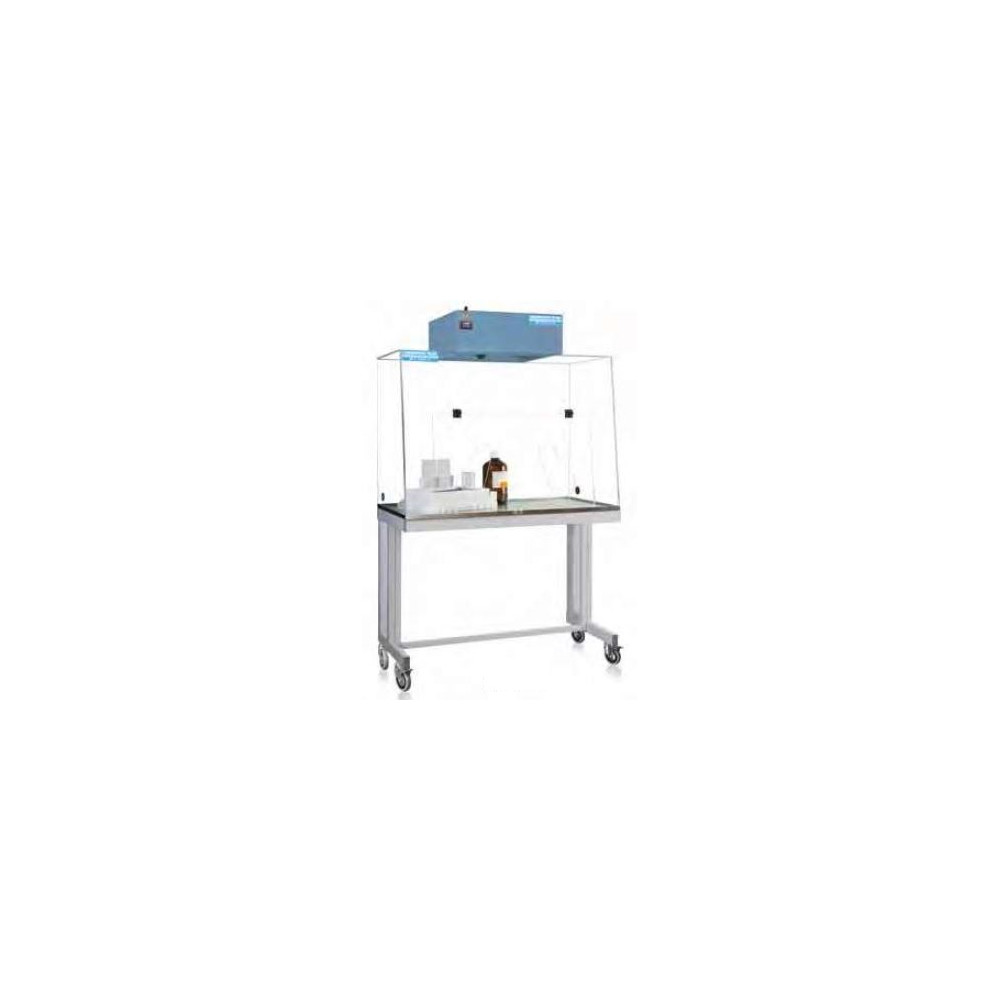
All our ASEM® fume extraction hoods are tested in the factory for the containment index and certified in accordance with the standards EN 14175 2-3-4-5-6-7 and UNI TS 11710.
USE
Collective protection device for the user, certified according to EN 14175 and UNI TS 11710.
Extraction of vapors and dust from the work volume so that no chemical concentration reaches the operator and the laboratory.
Prevention of the formation of an explosive atmosphere in the work volume. Protection against chemical splashing.
Chemical fume hoods are not suitable for handling biological agents or microorganisms.
Fire reaction class "1".
STRUCTURE
Entirely constructed of steel sheet.
Built with steel elements, in interdependent modules, which can be assembled and mechanically connected, allowing for interchangeability or replacement of individual elements.
Sides, rear panel, double extraction, and ceiling made of 15/10 - 10/10 mm electro-galvanized steel sheet, cold-pressed and painted, after degreasing treatment, with an initial epoxy primer application and 2 subsequent applications of thermosetting powders of at least 90 microns, where the paint undergoes drying and baking treatment in a thermal chamber at 210°C and fuses with the metal part.
Powder coating with RAL 9010 WHITE pigment.
The quality and adhesion of the coating are verified according to UNI EN ISO 12944.
Hexagonal steel screws allow for quick assembly of the various components, creating a particularly solid and robust supporting structure.
Adjustable acid-resistant feet at the base allow for leveling of the structure.
BODY
The extraction point is made on the top of the hood: flange/collar with a 250 mm diameter. Control elements are located on the exterior of the hood, on the triangular lateral deflectors.
The double bottom of the extraction area, necessary for uniformly capturing gases and vapors even on the work surface, is achieved by installing a removable panel for sanitization, with the same characteristics as the walls, and with a number of openings distributed for optimized ventilation.
DEFLECTORS
Over the entire height, without corners, to direct the air from the sides of the hood inward; additionally preventing "backflows" and flow reversals.
Made from 12/10 mm electro-galvanized steel sheet coated with epoxy paints. Removable panel for inserting new utilities or for maintenance.
Cable pass-through with cover.
DOUBLE BACK BOTTOM
Designed to accommodate removable trusses and stands, and is dimensioned based on the width of the chemical fume hoods.
Easily removable for cleaning; this operation can be performed by the users themselves without the need for a specialized technician.
This allows for a reduction in the maintenance costs of the chemical fume hood.
SLIDING DOOR
The sliding door is made of a 1 mm thick galvanized steel frame, phosphatized, and coated with epoxy powder fixed by passing through a thermal tunnel at 180°C and/or aluminum. 2 or 3 layers of laminated Securit glass 3 + 3 + PVB conforming to UNI EN12543-1 and EN 12600.
The sliding door opens and closes at any position via a manual or motorized system. The glass can be opened and closed horizontally so that it can act as a complete screen for the operator's entire body, allowing manipulation inside the hood.
The sliding door is equipped with a mechanical locking system for vertical opening. The opening is possible up to 300 and 450 mm from the work surface. For maintenance or insertion of bulky tools, this system can be unlocked to allow the complete opening of the guillotine.
The hood is also equipped with an optical/acoustic alarm system that activates when the operator voluntarily opens the hood, signaling the anomaly.
Lowering the sliding door reactivates the closing system automatically, and the optical/acoustic alarm turns off, in compliance with EN 14175 (optional).
The sliding door frames are equipped with a safety device that immediately blocks the door in case of breakage of one of the toothed straps of the counterweight. These counterweights are placed behind the back wall, outside the hood, or at the front and are supported by stainless steel AISI 316 ropes with a 3 mm diameter or toothed belts with a steel core, low-friction aluminum pulleys with an anti-slip device, ensuring a limited displacement force.
They are outside the suction volume and therefore do not come into contact with corrosive vapors that may develop during manipulation inside the hood.
Safety device with immediate locking in any position of the sliding door in case of imbalance or cutting of cables.
End-of-travel position with a safety finger block in case of accidental closure.
In accordance with EN 14175, the manual force required to open or close the guillotine must not exceed 30 N per linear meter.
These safety systems are controlled during production and verified during audits by Bureau Veritas.
METAL SUPPORT FOR WORK SURFACE
Built with TIG-welded steel tubes, allowing for high load capacity and height adjustment.
The protection treatment is performed through pickling and hot phosphatization to remove any slag or grease residues, then electrostatic powders with RAL 9010 WHITE pigmentation are applied.
The enamel undergoes a drying and curing process in a thermal chamber at 210°C, where the enamel fuses with the metal part. Hexagonal steel screws allow for quick assembly of the frame to the self-supporting base, creating a particularly solid and robust structure.
HOOD ROOF
Completely made of 1.2 - 1.5 and 2 mm thick galvanized steel sheet, phosphatized and painted with epoxy powders fixed by passing through a thermal chamber at 180°C. On request, it can be made of PVC with the same aeraulic characteristics as the steel roof.
HOOD CEILING
In the double extraction section, the ceiling is equipped with a large number of ventilation openings, designed to direct the suction vapors evenly to avoid turbulence. An opening with a polycarbonate optical panel is created on the roof to accommodate the lighting.
This panel also serves as the preferred escape route in case of explosion and/or pressure increase inside the hood.
On the hood ceiling is the 250 mm diameter exhaust collar, optionally equipped with a condensation collection system to prevent condensation from falling inside the hood due to heat exchange within the tubes with different temperatures between the laboratory and the outside.
It is also possible to equip the chemical hood with the SA7000 system, which allows you to extract cabinets under the chemical hoods, ensuring the necessary ventilation and air exchange.


 Italiano
 Français
 Español
 Deutsch